Bitcoin’s first minute of the hour moved more than the other minutes in my earlier intrahour study. Could that movement support a one-minute directional trade after costs? Under the assumptions I fixed for this screen, even a benchmark that knew the direction in advance lost 19.46 basis points per interval, on average. Its two-sided 95% interval was −19.76 to −19.12 bps. The frozen classification was NOT_ECONOMICALLY_PROMISING.
This is an exploratory screen, not a trading strategy or a fresh holdout. The 2025–2026 sample had already been exposed in the earlier study. I froze the economic method before inspecting these economic results, on 5 November 2026, after the market observations and earlier analysis had taken place.
From relative movement to trading costs
The earlier study normalized each minute’s absolute return by the average minute in the same completed hour. That dimensionless ratio describes relative volatility; it is not a return in basis points. Here I used log price changes multiplied by 10,000, so one basis point is approximately 0.01% for small returns. The mean absolute open-to-close move in minute 00 was 4.54 bps. Mean absolute close-to-close movement in that minute was also 4.54 bps, compared with 3.83 bps for minutes 01–59. Their difference was 0.71 bps, with a two-sided 95% interval of 0.61 to 0.82 bps.
I used Binance Vision BTCUSDT spot one-minute candles from 1 January 2025 through 30 September 2026 UTC. Of 15,312 hours, 15,311 were eligible; the first lacked the preceding candle needed for the comparison. The sample contained 918,720 rows and 92 UTC weeks. Each eligible hour received equal weight.
An impossible benchmark
For each hour, the oracle takes the absolute value of the first candle’s open-to-close log return. It knows the direction beforehand, which no actual trader can do. The candle open and close are hypothetical fill prices, not guaranteed executions. Short exposure also requires borrowing or another instrument. This benchmark is a ceiling only for the specified directional open-to-close approach under these assumptions, not for all intraminute trading.
The primary assumption was 10 bps in fees on each side plus 4 bps round-trip spread and slippage, or 24 bps total. These are hypothetical costs; spread and slippage were not measured. The fee assumption is consistent with the published regular-user Binance spot fee schedule, without assuming a particular account tier. I subtracted the fixed costs from each interval’s oracle return. The two-sided percentile interval uses 10,000 fixed-seed resamples of UTC-week clusters. It relies on weeks being sufficiently representative and independent; a single venue and changing market conditions limit generalization.
The frozen rule classified the screen as economically promising for follow-up only if the interval’s lower endpoint was strictly positive; an upper endpoint strictly below zero meant NOT_ECONOMICALLY_PROMISING. Otherwise it would be inconclusive. The primary interval was wholly below zero.
Cost sensitivity and baselines
The table shows the perfect-direction oracle’s mean net log return in bps per interval. Extra costs are round-trip, in addition to fees on both sides. Positive net intervals are not necessarily executable or profitable in practice.
| Fee per side | Extra 0 bps | Extra 2 bps | Extra 4 bps | Extra 8 bps |
|---|---|---|---|---|
| 0 bps | +4.54 | +2.54 | +0.54 | −3.46 |
| 2 bps | +0.54 | −1.46 | −3.46 | −7.46 |
| 5 bps | −5.46 | −7.46 | −9.46 | −13.46 |
| 10 bps | −15.46 | −17.46 | −19.46 | −23.46 |
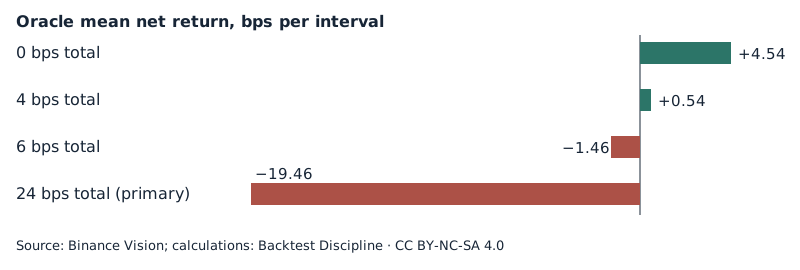
The chart compares total round-trip costs of 0, 4, 6 and 24 bps; the complete table above shows how fees and additional costs combine.
The public aggregate result extract includes intervals and positive-net fractions for all 16 assumptions. At the primary cost, 1.31% of intervals had positive oracle net return. At zero costs, the mean was +4.54 bps, with a 95% interval of +4.24 to +4.88 bps. At 2 bps per side plus 2 bps extra, it was −1.46 bps, with an interval of −1.76 to −1.12 bps.
For context, the gross signed long-only mean was +0.04 bps (95% interval −0.12 to +0.21); the hypothetical short-only mean was −0.04 bps (−0.21 to +0.12). Neither is a fitted signal. Applying the primary 24 bps cost gives means of −23.96 and −24.04 bps respectively.
What the screen leaves open
I stopped this particular one-minute directional investigation under the frozen assumptions. The result does not rule out other intraminute strategies, volatility applications, or uses of execution timing. It does not establish a predictive signal or trading profitability. The earlier within-hour normalization used the completed hour and cannot itself supply a signal at the hour boundary.
The platform integrity check passed for the sealed artifacts and bound source identities. A separate study-owned semantic replay also passed, using the same calculation implementation, supplemented by independent synthetic examples. It is not an independent implementation or third-party audit. Two complete runs remain in the research record: the second added a previously omitted close-to-close confidence interval without changing the frozen method. Hashes identify bytes; they do not independently prove chronology or validity. The public aggregate and verification extract do not provide a complete independent rerun.
The sealed result SHA-256 is d7d67dcc6272783ed74aef8df05a678d65d8c224974eaf4d9554e590dfceea43. The semantic verification is an extract of the sealed check.
Data attribution and reuse
The underlying data are Binance Vision BTCUSDT spot one-minute archives. Backtest Discipline calculated absolute and signed log returns, applied hypothetical costs and aggregated them by eligible hour and UTC-week bootstrap. The covered derived analytical dataset, numerical table and chart on this page are offered under CC BY-NC-SA 4.0, with attribution to Binance Vision and Backtest Discipline and share-alike for covered adaptations. Binance Vision Dataset Terms and general terms also apply. This notice does not relicense unrelated article prose, site infrastructure or independently authored source code. Binance did not endorse this analysis. Raw archives and timestamped candle series are not distributed here.